
Standing Firm with Saudi Arabia
By Junaid Qaiser
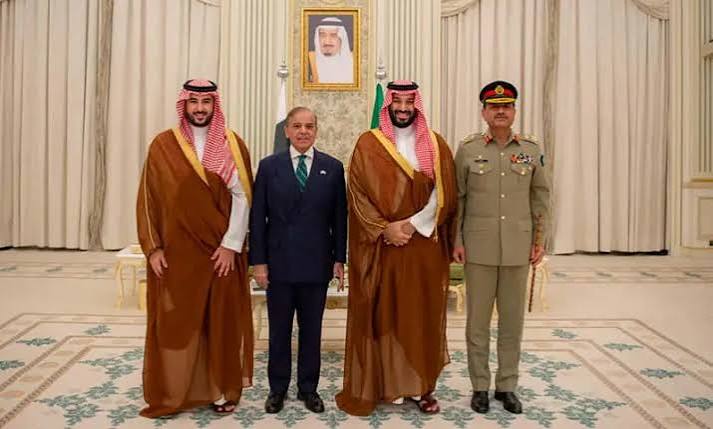
Prime Minister Shehbaz Sharif’s recent conversation with Saudi Crown Prince Mohammed bin Salman came at a critical moment for the Middle East. The Houthi attack on Saudi oil tankers in the Red Sea has once again exposed the fragility of regional security and highlighted the growing risks facing one of the world’s most important maritime corridors. Pakistan’s swift and unequivocal condemnation of the attack was not merely a diplomatic gesture; it was a reflection of a long-standing principle that has guided Islamabad’s relationship with Riyadh for decades.
The attack on commercial vessels in the Red Sea represents far more than a localised security incident. It strikes at the heart of international trade, freedom of navigation and the stability of global energy markets. The Red Sea and the Bab al-Mandeb Strait serve as critical gateways linking Asia, Europe and Africa. Every disruption in these waters carries consequences that extend well beyond the region, affecting supply chains, shipping costs and energy security across the world.
Prime Minister Shehbaz was therefore correct in describing the attacks as unacceptable. International commerce depends on safe and uninterrupted maritime routes. When commercial shipping becomes a target, the effects are felt not only by governments but also by ordinary citizens through higher costs and economic uncertainty. The protection of these routes is a shared international responsibility, and any attempt to undermine them threatens the broader rules-based order that governs global trade.
For Pakistan, however, the issue is even more significant. A substantial portion of the country’s trade and energy imports relies on maritime routes connected to the Red Sea. The Bab al-Mandeb Strait is not simply a distant strategic chokepoint discussed in policy circles; it is an artery through which Pakistan’s economic interests flow. Instability in these waters directly affects Pakistan’s national interests.
This explains why Islamabad’s response has been notably stronger than that of many other non-Arab states. Pakistan did not limit itself to expressions of concern. Instead, it made clear that any hostile act against Pakistani vessels or maritime interests would be regarded as a serious threat to national security. Such language reflects a recognition that maritime security has become inseparable from economic security in the modern world.
Yet the significance of Pakistan’s position cannot be understood solely through the lens of trade and commerce. It is also rooted in the unique and enduring relationship between Pakistan and Saudi Arabia. The ties between the two countries are not transactional; they are built on decades of mutual trust, strategic cooperation and genuine goodwill. Through times of crisis and stability alike, both nations have consistently stood by one another.
The conversation between Prime Minister Shehbaz Sharif and Crown Prince Mohammed bin Salman underscored this reality. By reaffirming that Pakistan’s political and military leadership stands firmly with Saudi Arabia, the prime minister was expressing a sentiment shared by many Pakistanis. The Kingdom occupies a special place in Pakistan’s foreign policy, and its security has long been viewed as closely linked with Pakistan’s own strategic interests.
The Strategic Mutual Defence Agreement signed in 2025 has further strengthened this partnership. The agreement institutionalised what had already existed in practice: a shared commitment to each other’s security and stability. Such arrangements are not designed to encourage confrontation but to deter aggression and preserve peace through solidarity.
Pakistan’s support for Saudi Arabia should not be interpreted as a call for escalation. Islamabad has consistently advocated dialogue, diplomacy and peaceful resolution of disputes. It has often sought to play a constructive role in reducing tensions across the Muslim world and beyond. Supporting a close ally while promoting regional stability are not mutually exclusive objectives; they are complementary ones.
The current crisis also serves as a reminder that attacks on maritime commerce rarely remain isolated events. History shows that instability in strategic waterways quickly becomes a global concern. Markets react, shipping routes change and economic uncertainty spreads. The international community therefore has a collective interest in ensuring that vital sea lanes remain open and secure.
At the same time, there is a broader lesson for the region. Lasting peace cannot be achieved through threats to commercial shipping or attempts to weaponise strategic waterways. Such actions ultimately harm regional economies, undermine investor confidence and increase the risk of wider conflict. The path to stability lies in diplomacy, restraint and respect for international law.
Pakistan’s response to the Red Sea crisis reflects both principle and pragmatism. It supports freedom of navigation, defends international law and protects vital national interests. But above all, it reaffirms an enduring commitment to a brotherly nation that has stood alongside Pakistan for generations.
In the final analysis, Islamabad’s message is clear. Pakistan seeks peace, stability and dialogue, but it will not remain indifferent when the security of Saudi Arabia is threatened. The bond between the two countries is rooted in history, strengthened by shared interests and reinforced by mutual trust. Standing firm with Saudi Arabia is therefore not merely a diplomatic choice for Pakistan; it is a reflection of a partnership that has weathered decades of regional challenges and remains as important today as ever.
Comments
Most Read
Pakistan’s Red Line

Sohail Alam congratulates General Aamer Raza on his promotion and expresses appreciation for PAF

Defending the Red Sea’s Lifeline

Pakistan’s Role as a Sincere Mediator

CBF Pakistan Signs MoU with Superior University to Promote Education and Leadership Development

Standing Firm with Saudi Arabia
Pakistan's Resurgence
No comments yet.